Showing posts with label culture. Show all posts

Friday, March 21, 2014

Flashback Post


Flashback Post:

I learned something today about living in a new culture, even though I am still living here in Minnesota. In one of my graduate classes, we were talking about the experience of culture shock. One student was particularly anxious to share her ideas: She was frustrated with the place, frustrated with people who did not care about her and who didn’t have time for her. Frustrated that there was nothing to do but sit in her dorm room, frustrated that she didn’t have access to good shopping without a car. Frustrated with the weather. frustrated that people might say hi one time and then ignore her the next time. In all her explanation of culture shock, the rest of the class started to feel heavy and guilty. I myself started to shift uncomfortably in my chair.

And I realized several things—when people ask to hear about your experience in their country, they don’t want to hear of all the negative experiences and loneliness you might be feeling. Even though you might feel this way, this is not the place to express it.

As this student continued to lament how miserable she was here and how selfish everyone is, I started to feel some resentment toward this fellow student. Who is she to tell us that we are unfriendly, that we don’t have time for her, that we are self-focused.
Does she know of the pressure we face daily? We are not from the Mediterranean—we were not raised to value relaxation and socializing. We were taught efficiency and hard-work--the keys to a good life, to good self-esteem. And yet I couldn’t help but wonder if she didn’t have a point. Why do we value things such as "hard work" and "efficiency?" Are we better off for these values? It’s hard to know. I’m confused about life right now. But, I did realize that the native people do not want to hear about your negative perceptions of them or their country. So, when I am in China or any other country, I need to be sure that I do not focus on the negatives, but appreciate the experience for what it is, a new one. 

(This post was written in April, 2007) 

Saturday, February 22, 2014

A Chinese New Year's Superbowl Party!

How many parties can you fit into one event? Well, my friends packed a whopping three parties into one. Their invitations called it "The Perfect Storm" and the party was perfect indeed. The party was on Superbowl Sunday. It was also during Chinese New Year, and finally, it was the host's Birthday. Did I mention that it was also the couple's housewarming party? (I guess that makes 4 events packed into one.)

Rob and I went not knowing exactly what to expect since we know the couple but not many of their friends. We were in for a culinary treat though. My friend had one of her friends cooking Korean barbecue. She had also prepared an entire table of hot pot. Finally, there were delicious chocolates on the table, tiramisu, and birthday cake for desert. There was also a good selection of beverages and vegetables -- two of the staples of any good party.

At first, we all mingled happily upstairs. Pretty soon, the game came started, and the guy crowd all headed downstairs to the man cave. I stayed downstairs for about 15 minutes, but the Super Bowl was pretty disappointing. In the meantime, I could hear loud happy voices coming from upstairs--and the voices were speaking Chinese, and I could not help myself; I had to join them.

Upstairs, everyone was happily playing Jenga. But not just any Jenga: the loser of the game had to sing a song for everyone. (The pressure was on.) After that game got too intense, my friend made up a game. Yes, that's right--she made it up on the spot; she's amazing. The premise of the game? Each person around the table rolls the dice. The person who rolled the largest number asks the person who rolled the smallest number a question--a personal, intimate question mostly. For example, they asked me what was the most romantic gift that Rob ever gave me.  (I don't think Rob would appreciate it if I shared it on here.) Being with these friends, playing games, singing, and speaking Chinese filled my heart with such a fullness.


Sunday, February 02, 2014

10 After Effects of Living in China

After living in China for four years, I noticed some things about the way I interacted in American society that made me slightly different from the majority of people around me.

Here are 10 of those after effects from living in China:

10. You are amazed at how much some things everything costs.

9. You are frequently overwhelmed by seeing an entire aisle of cereal choices in the grocery store.

8. You ask your friends questions such as "How much money do you make?" and "How old are you?"

7. You tell people that you cannot make it to their place because "I have something to do."

6. You shower less than 3 times a week (in the winter.)

5. You wear layers of clothing (in the winter.)

4. You call your coworkers "colleagues."

3. You spit in public.

2.  You carry tissues and hand-sanitizer in your purse at all times.

1. You feel sentimental and home-sick whenever you hear Chinese being spoken around you.


(This blog is written with thoughts of my friends Genevieve and Kate who I met through living and working with them in China.  Right now, they are in Thailand lifting up overseas workers.)

Sunday, August 14, 2011

Re-Entry. . .

People have told me I need to take time to journal about China. No problem. I like journaling. But people never tell me what exactly I’m supposed to journal about China. I am searching for some prompts or helpful psychoanalytical questions to get me started. For example, “If you could describe your time in China as a color, what color would it be and why?” and so on. But there are no prompts, and I don’t have the super important books I’m supposed to read about re-entry. So, I just flounder around in my thoughts a lot and sometimes write them down on paper or sometimes let them spill over while talking with my “foreign” friend who is further along than me in the adjustment period.

At this point in the process, mostly I feel a huge relief that I don’t have to get on a plane after merely five weeks of being home with family to head back to China. I feel thankful that I haven’t had to stock up on a years’ supply of things I might possibly need: hand-sanitizer, deodorant, hair gel, band-aids, shavers, shaving cream, and so on. Not to mention all the baking goods that seemed so important to me my first year in China. I feel thankful I don’t have to go buy appropriate teaching shoes or blouses that actually fit. I feel happy that I don’t have to buy local snacks such as beef jerky, Chico-sticks, and licorice to stuff into my suitcase. Happy that I haven’t looked at my passport for 5 weeks. Happy that I don’t have to say good-bye to family with such permanence as I cry through most of the domestic flights and layovers on the return journey to China. For these things, I feel relieved and contented. It feels amazing to relax through an entire August without dramatic farewells.

But sometimes when I am shopping at the super market, I think I hear a few Chinese words coming from Caucasian looking kids, and then I realize that I’m just hearing things. I have dreams about my friends in China. In the dream, we are talking, and my friend usually has some big problem she is dealing with. I can’t help her, and usually end up scolding her in the end, telling her she should be more polite. I wake up feeling sad and homesick. I look for these same Chinese friends online. I talk with them late into the night. I have a new hunger to watch all Chinese movies that have ever made it to the States. I am finally ready, yet again, to read books about China after having no desire to do so for the past 4 years. I can’t get enough of Chinesepod. I miss fried noodles. I miss using chopsticks. I say weird things about “harmony” and “convenience.” I watch movies set in China and cry even during the happy parts. My new favorite color is China red. And it has only been 6 weeks since I have been back in the States.

And my thoughts have no resolve about “what’s next?” And in fact when people ask me what I’m going to do next year, I feel kind of angry, and then I feel sad and depressed because this is the culture I have come back to. . . where you need a 5 year plan. But in China, you don’t even really need a 5 hour plan. But I guess, there is some beautiful balance to be struck between both cultures, some way to hold on to the good points of both without allowing the bad points to be more annoying than they should. And until I figure out how to do that, I guess I'm here with my jumbled thoughts asking myself "What's next?" and kind of scared what the answer might be.


Saturday, May 07, 2011

Internal Heat

Two weeks ago, it turned really hot and humid here overnight. From wearing layers, to sweating in one layer, my body and my closet were not prepared for the quick change. I sweat a lot during the initial humid period, and I also had a slight break-out on my forehead. People were quick to point out both issues to me: “You’re sweating” and “you have some acne on your forehead.” Awesome. However, I have learned a new way to deal with both these problems. You simply have to tell people that you’re internal “qi” or heat is up, 上火了。 This is an acceptable reason for all these small problems and near as I can tell, it’s a fair topic for small talk since people have readily told me before that I am 上火了 or that my internal heat is up.

It’s also an easy problem to fix. You just have to eat more fruit, especially watermelon, and drink some chrysantheum tea. So now, when people tell me I’m sweating or point out some pimples, I simply say 我上火了. They nod with satisfaction and tell me to drink some tea and eat green bean popsicles or fruit. (Disclaimer: when I looked up the Chinese characters for 上火, it said this phrase can also mean to be angry at someone. Maybe I have accidentally been telling people "I"m angry" and then they think that explains why I'm sweating...but it does not explain why they continually recommend the same foods.) Internal heat, got you in a sweat? Try some refreshing chrysantheum tea and throw in some guo qi berries for good measure.


Thursday, April 14, 2011

TEM-4 and the Cinema

Tomorrow, we are showing an English movie, Cheaper by the Dozen, for our sophomore students to celebrate the completion of their TEM-4 exam. Originally, we had planned to have a big party for all our students, but since together we teach about 800 students, it just wasn't practical.

If you think of it in the next 24 hours or so..lift up our students. This exam is a big deal for them; they get two chances to pass it, this year and next year. If they don't pass it, they can't technically graduate from the University. Most of the students have been sacrificing what little extra time they have to stay in the library and prepare for this test. As I was heading to class today, one student said "the end of the world is tomorrow" (referring to the test). That's how much of an intense reality this test is for students. So, hopefully they will be able to have a right attitude about this test and if things don't go well, we also hope they feel comfortable enough to talk with us.
On an unrelated note, 2 weeks ago, I went to the cinema in Hengyang with my friend. We saw an English movie called "War in Los Angeles" or something like that. It was about aliens attacking the world. I wouldn't actually choose to ever watch this movie on my own volition, but my friend said she heard it was good, and I just went with the flow.

Then, my friend took me to a spa. Sounds nice, huh?
Actually, it was a big awkward. My friend said we should have a shower before the "spa". Okay, no problem except the workers (2 or 3 young girls) were just hanging out in our room as we were supposed to undress and put on a robe to go have a shower. Yeah, I was reminded of shower time after PE class all over again. The shower was nice though and in its own private room. They they massaged our faces for a bit and put some type of mask on us. The mask made our faces whiter...do you notice? I decided I don't love masks...especially when they cover up your eyes. After the "spa" experience, I let my friend put eye make-up on me. It was a bit thick, but I think she enjoyed it. It was about 10:00 when we finished these two activities; then we had dinner.

Friday, April 01, 2011

Sunday afternoon Walk

Good idea--biking along the river-walk on a sunny day.

This man's pose reminded me of a hobbit enjoying a sunny day in the Shire.

Caroline and Jenn were pretty insistent we stop and take some "senior portraits" (wink, wink).


A river shack / boat...I think it might be a gas station.
I like how this photo shows the dichotomy between the old and the modern in China.

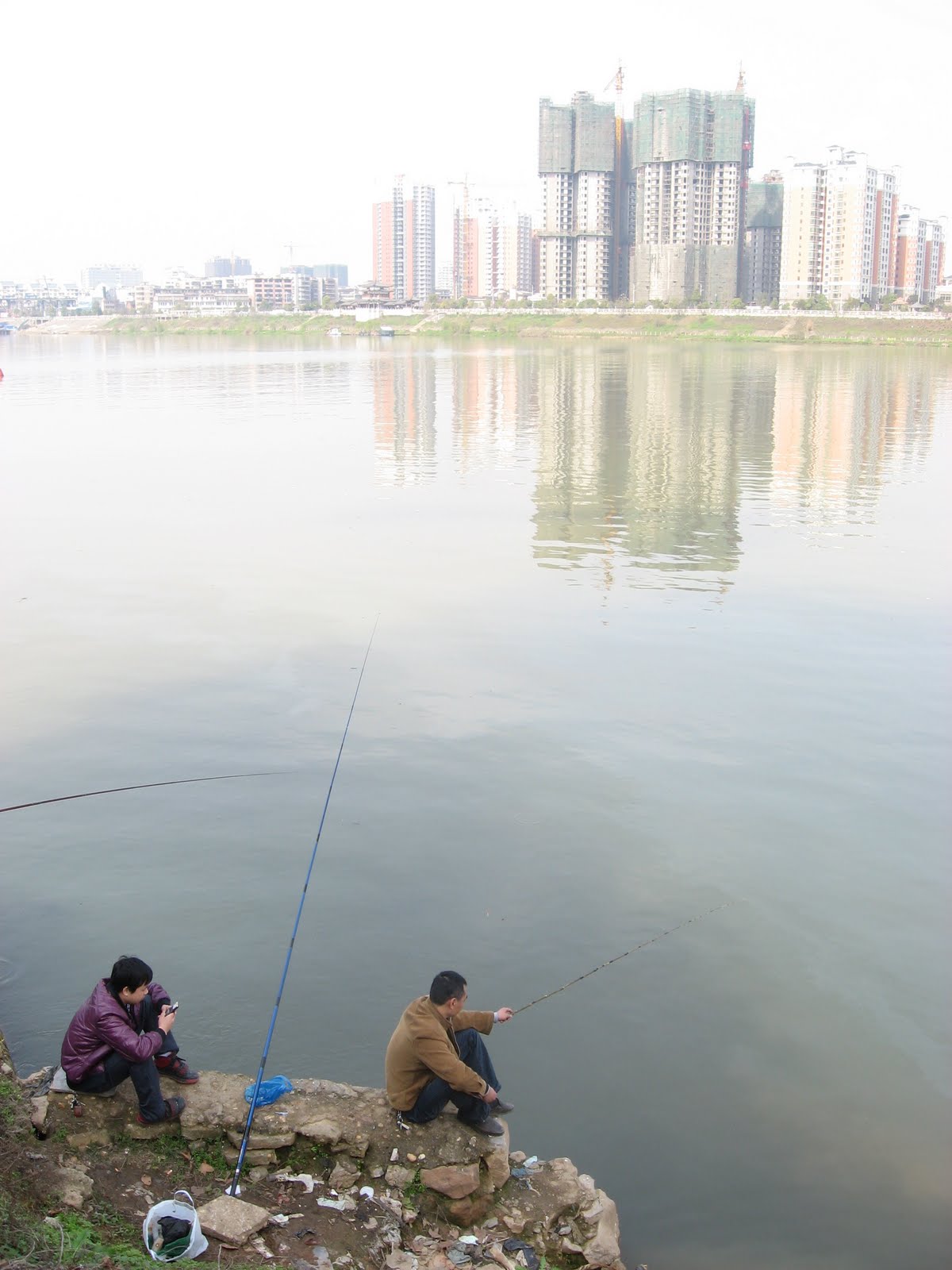
This man is wearing some kind of battery pack that has a wire connected to his fishing equipment. When he puts the wand in the water, there is a buzzing, and when the fish touch the wand, they receive an electric shock. (Okay, actually I have no idea how this "wand" works. I'm just making a wild, uneducated guess.)

Sleeping on the job or working in his sleep. . .

Sunday, March 27, 2011

The Jobs you Will See, Part 2

These photos are part 2 of the blog series, "The Jobs you Will See." Today on our walk, we found these men selling fresh fish on the street. I think the man in the orange blazer is in charge of the fish selling operation, but I didn't ask questions. If I ever bought fish, I think I would also buy them from a man wearing an orange blazer; it gives him a little something extra in a friendly "Mr. Rogers" way.

Sunday, March 20, 2011

What does your pharmacy offer?

A lot of pharmacies in Hengyang offer free entertainment. Just bring warm clothes and don't be too picky about what is on TV that night or who is controlling the remote.

Saturday, March 19, 2011

Hao Zou. . .

I have posted before about funeral traditions in Hengyang, but I've never actually experienced one first hand until last week-end. I was sitting around feeling lethargic and distracted, wondering about the week-end plans, wishing my friends were more initiative. Well, I should know that whenever I feel this way in Hengyang, the feeling lasts about all of an hour before something demanding and unexpected happens. And this day time was no exception.

One of my closest local friends, a mid 20 year old entrepenuer named "Ivy," called me to say her grandfather was "dead" or "dying." I wasn't sure, but I knew it was serious. I offered to accompany her to his house and she surprisingly agreed (I now interpret agreeabilityas a yes in Chinese culture). When we got to her grandparent's place, her grandfather was still alive, covered in blankets on a hospital bed and breathing very heavily. Ivy's grandmother was moaning and bustling around in what seemed like one fluid moment. Ivy's relatives were also busying themselves, taking turns standing by his side, calling Ivy's uncle and cousins who lives in the States, and monitoring his pulse.

Ivy's mom is a nurse, and she is also a strong believer. I had brought the chinese / english book with me, and she read Psalm 23 out loud to her father. She also came over and told me how she had taken him to the fellowship place just two weeks ago, and although he could not talk, his eyes were wide and alert as she shared with him. As I looked over at this old man, clearly in pain, barely hanging on, I prayed that the work had already happened in his heart, and now I asked that the Father might release him from the prison of his broken-down, weary body.

The last time I had seen Ivy's grandfather, had been nearly a year ago when Ivy called me on the phone hysterical and said, "My grandpa's fallen off the ladder and the doctor said he has bleeding in his head." That time, I accompanied Ivy to the hospital where her grandfather was also breathing incredibly heavily and also bleeding from his ear and clearly in immense pain. Since that day, one year ago, he has not been able to communicate and has been largely confined to a bed or a chair. Since that day, he had also had trouble eating and digesting food and never been able to fully recover his strength.

And now, here I sat with Ivy and her family a year later. After about an hour, the family had gotten something similar to skype set up so Ivy's grandfather could see his son in the states and hear his voice. It was shortly after that moment, that his breathing became gaspy and I knew his condition had turned as the family crowded around his bed and started crying and begging him to hang on. I heard clearly, Ivy's mother saying to her father "Ba ba, hao zou" which means basically "Father, may your journey be smooth." And, then he was released.

This moment was the most emotional one I have ever experienced in my time in China. The few pouches of handkerchiefs hardly seemed to be enough for the family. I was reminded not only of Ivy and her family's farewell, but on a personal note, our family's farewell to Grandpa Friesen a little more than a year ago. Although I could not be there for his passing, I got to be there for my friend as she faced the reality. I was humbled, thankful, and melancholy through the experience.

Oh man, there is so much more to write. There were so many things that happened after this moment related to funerals, and local traditions but let me rest here.

Wednesday, January 26, 2011

Reverse Culture Shock

Ice cubes in everything.
Plastic bags given away like they grow on trees.
Understanding every word spoken.
Climate controlled everywhere.
Big people.
No staring.

Wednesday, January 19, 2011

More on Chinese Parenting Styles


Lawyer and writer, Amy Chua, has recently published a memoir that has been cause for much controversy. Ever since reading an article titled "Why Chinese Mothers are Superior," a short excerpt from her memoir, I have a bone or two to pick with her, and it seems a lot of people have similar feelings. People are criticizing her article from multiple angles. Some of the criticism includes her stereotyping and generalization of "Chinese" parenting styles. Anytime people stereotype an entire group of people, they are going to be wrong. There are going to be people within that group who do not fit the mold or who defiantly challenge it. But Chua does give a disclaimer in her article that she is using the term "Chinese mother" loosely and does not expect her ideology to be true for all Chinese mothers.

Other criticism revolves around Chua limiting her daughters' ability to develop socially. While Chua writes that the stereotypical American parents are not strict enough on their children in not making them practice their instrument long enough or in not demanding academic excellence. Interesting enough, in one editorial written by New York Times writer Daniel Brooks, he criticizes Chua for coddling her children but simply in a different way than Chua sees coddling. He writes that Chua, in not letting her children be involved in social events such as slumber parties or school drama, is in fact inhibiting their social development and "protecting them from the most intellectually demanding activities because she doesn’t understand what’s cognitively difficult and what isn’t" (Brooks). He goes on to argue that learning how to operate within the social contexts that Chua withheld from her children is in fact functioning at a higher cognitive level than simply gaining book knowledge or memorizing a piece of music. I applaud Brooks for pointing out the importance of social interaction in helping children develop.

Seeing Chinese parents in action first-hand by living in China, I often shake my head at what they push and praise: academic excellence, beauty, and special talents. It is not that I don't think those things are important or have value, but I don't think they should be the main things in life. My friend who has a hellion of a 10 year old son often talks to me about how she is worried because he is "too slow" when he does his homework. I think I would be a bit more worried about some behavior issues than his "slow speed" of completing homework. But she does not seem to be concerned about those issues and just says, "Oh he's a bit naughty" and then she laughs nervously, and we talk about something else. Another young girl who has just started High School has taken up violin lessons. Her parents use her one morning a week when she does not have school (Sunday) to drag her to violin lessons. Perhaps she is excited about her violin skills, but inside I can't help feeling that these kids are being pushed to their limits and perhaps also to their breaking point.

At the same time, it is true that in China, one' s academic success, especially while younger does largely determine their fate in life. In America, we have so many examples of how people jump from rags to riches. But in China, this idea is not as common or much of a reality. People's jobs are either determined by their parents' position in society or by their ability to excel academically, namely doing well on their college entrance examination so that they can make it into a top University in their desired field.

It seems like the best form of parenting would be a combination of both, expecting, but perhaps not demanding academic excellence while also giving children opportunity to develop socially along with their peers. With that said, I still have no idea which is the right or best way to parent and thankfully for now, I don't have to.

Sunday, November 28, 2010

Thoughts on orphans (part 2)

A couple of weeks ago, I wrote about a girl at the orphanage center named Lulu. (see post Thoughts on Orphans) Recently God has changed my heart towards her. Instead of seeing her as the antithesis at the center, I see her as the person who needs the most love. Instead of waiting for her to need attention and seek it in negative ways, we try to lavish on her positive attention.

One of the main ways to give her attention is to dance with her. She loves to dance, and she loves to dance with a partner. Lucky for her, I also love to dance and sing, so I’m more than happy to accompany her. Most of the time, we dance in the room that has all the toddler like kids, (who are actually 4 or 5 years old) sitting in red, car-seat like chairs propped against the wall. We dance back and forth in front of them. I usually sing one of the two or three songs I know in Chinese, and then I revert to “I could have danced all night” and Fiddler on the Roof’s “Sunrise, Sunset.”

Lulu still lashes out, and I’m personally still a bit scared of her when she does especially after my friend showed me the purple bite mark that Lu lu left on her. But, it also seems like Lulu is able to respond to discipline. My friend will stand with her against the wall in a kind of “time-out.” This is the only discipline though that Lu Lu seems to get though since the Chinese carers have said that Lulu is beyond control and if she wants something they simply have to give it to her or she will lose her temper and start beating up the other kids.

In their eyes, there is no point to discipline her as it only sets her off and makes their job of caring for her more difficult. But in a way, the failure to discipline Lulu is also a visible mark of the failure to love her. I heard a message by Matt Chandler who had this to say about discipline: “Discipline does not ensure love, but love necessarily produces discipline.” And his words are consistent with what the writer of Hebrews tell us about discipline: “No discipline seems pleasant at the time, but painful. Later on, however, it produces a harvest of righteousness and peace for those who have been trained by it” (Hebrews 12:11). The lack of discipline in this child, in these childrens' lives, is creating a dark and difficult road for their future. Oh that I would have the courage to love to the extent of disciplining in the face of rage and sharp teeth.